As 2025 comes to a close, this reflection looks back at the challenges faced by animals in India and the collective efforts taken to protect them. From wildlife rescue and advocacy to long-term systemic change, it highlights how compassion and commitment continue to drive progress for animals.
We want to take you back for a moment to the steep, sun-baked pathway leading up to Amer Fort in Rajasthan.
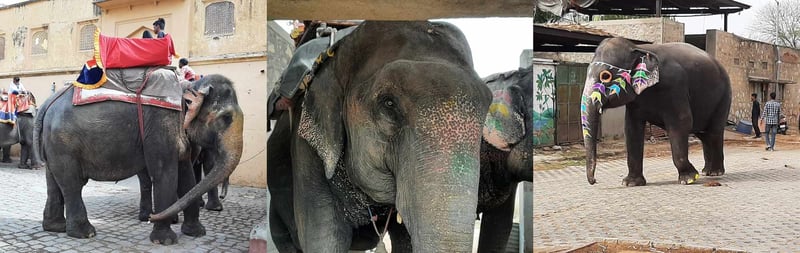
If you arrive early enough in the morning, you’ll see them — the elephants — swaying gently in the half-light, chains clinking at their feet. Their day has not yet begun, but they already know what is coming: long, painful climbs carrying tourists, bullhooks guiding their every step, and no true rest at the end of it.
It was scenes like this that moved us to begin our campaign years ago. And it is people like you who have kept it alive.
Why We Started This Journey
India is home to about 3,500 captive elephants. Many of them spend their lives in service to the tourism and entertainment industries. Some carry tourists on their backs. Some beg on streets. Some are used in weddings and festivals. Others live behind temple chains, giving blessings for a few coins.
But Amer Fort became one of the most painful symbols of this exploitation.
Here, 125 elephants were once forced to make dozens of steep trips every day. They lived in Hathi Gaon — a place with the largest number of captive elephants in one location in India — where many were kept chained, underfed, and pushed beyond their limits.
Many of these elephants were torn from their mothers as babies. Their spirit was broken long before a saddle was placed on their back.
We knew we could not look away.
And because of your compassion, neither did you.
The Change You Helped Create
Your support helped us stand up for these gentle giants — and it has mattered more than you can imagine.
20 of the sickest elephants have now been officially retired.
This is a huge victory. After our years of campaigning, the Rajasthan Forest Department finally stepped in, acknowledging both the medical and moral urgency.
- We helped reduce their working hours, giving them some relief from the exhausting daily grind.
- We exposed the risk of zoonotic diseases among sick elephants, raising alarms that authorities could no longer ignore.
- For the first time ever, the issue of captive elephants was brought into Project Elephant, thanks to our consistent advocacy.
- We took part in India’s first nationwide captive-elephant stakeholder meeting.
- Global tourism giants, including TripAdvisor, adopted animal-welfare policies that challenge harmful attractions like elephant rides.
We have more than twenty five wildlife friendly companies that have taken the pledge not to offer elephant rides as part of their itineraries. The companies that became wildlife friendly in 2025 in India include Her Expeditions, Svasara, Indian Wildlife Adventures, Pandav Hotels and Marttik Gardens.
We have engaged with the Prime Minister’s Office to obtain updates on the health status and retirement updates on the Amer Fort elephants. We have also sent hundreds of paintings and signatures made by school students to urge the Prime Minister of India to end elephant rides all over the country.
There has been massive media coverage of our work in mainstream and as well as specialist media coverage with exclusive interaction with Neil DeGrasse Tyson, the world’s pre eminent science populariser, who spoke on protection of animals.
None of this happened overnight. It happened because you believed these elephants deserved better.
The Challenges Still Ahead
While we’ve made meaningful progress, the road ahead is still long and complicated:
- There is no strong law yet that bans the use of elephants for rides and entertainment.
- Many mahouts and elephant owners depend on this trade and need alternative livelihoods.
- Elephants require safe rehabilitation spaces, and such facilities are limited.
- And finally, real change requires time, consistency, and sustained financial support.
Why We Cannot Stop Now
When we began, there were 125 elephants at Amer Fort.
Today, that number is 81.
This reduction didn’t happen on its own. It happened because we stayed — watching, documenting, asking questions, demanding better.
Our continued presence has ensured that not a single new elephant has been brought in to replace the ones who left. And that alone has prevented decades of future suffering.
But if we step back now, the gates will quietly reopen.
New elephants will be trafficked in.
Old patterns will return.
And everything we’ve fought for could unravel.
These elephants have no voice but ours.
And we have no strength without you.
Thank you, from the deepest place in our hearts, for standing with us — for believing in a world where elephants are no longer ridden, beaten, or chained for entertainment.
If you’d like more updates or want to know how else you can support this cause, we are always here.